
App Store Competitor Analysis: How to Do It the Right Way
Quick answer: App store competitor analysis is the practice of studying the apps you compete with for the same keywords and users (what they rank for, how their listing is built, and what they change) to find gaps you can win. The single highest-value output is the keyword gap: terms competitors rank for that you don't yet target. Do it continuously, not once, because metadata, rankings, creatives, and ratings all move.
Last updated: June 2026.
Your competitors have already spent time and money figuring out what works in your category. Reading their listings is the cheapest research in App Store Optimization: you get the benefit of their experiments without running them. This guide is a repeatable process: how to pick the right competitors, what to analyze, and how to turn it into keywords and changes you can act on.
What ASO competitor analysis is
It's the structured study of the apps competing for your visibility, with one goal: find opportunities you're missing and threats you should respond to. It is not copying a competitor's listing: a tactic that works for a 4.8-star incumbent can be unwinnable for a newer app. It's using their data to make your decisions sharper.
Step 1: Pick the right competitors
"Competitor" means three different things; analyze all three:
- Search competitors: apps that rank for the same keywords you target. The most important group for ASO, even if their app is quite different from yours.
- Category competitors: apps in your category and charts, your direct functional rivals.
- Brand-adjacent: the well-known apps users compare you to.
Aim for three to five you'll track closely. Going wider dilutes your attention; the value is in depth.
Step 2: Keyword overlap and gaps (the most valuable step)
This is where competitor analysis pays for itself. For each competitor, look at:
- The keywords they rank for that you don't: your gap list, and your most actionable output. If three rivals all rank for a term and you don't, that's a tracked-keyword candidate.
- Where you both rank: head-to-head terms where a metadata or rating improvement could move you above them.
- Terms only you rank for: your moat; protect them.
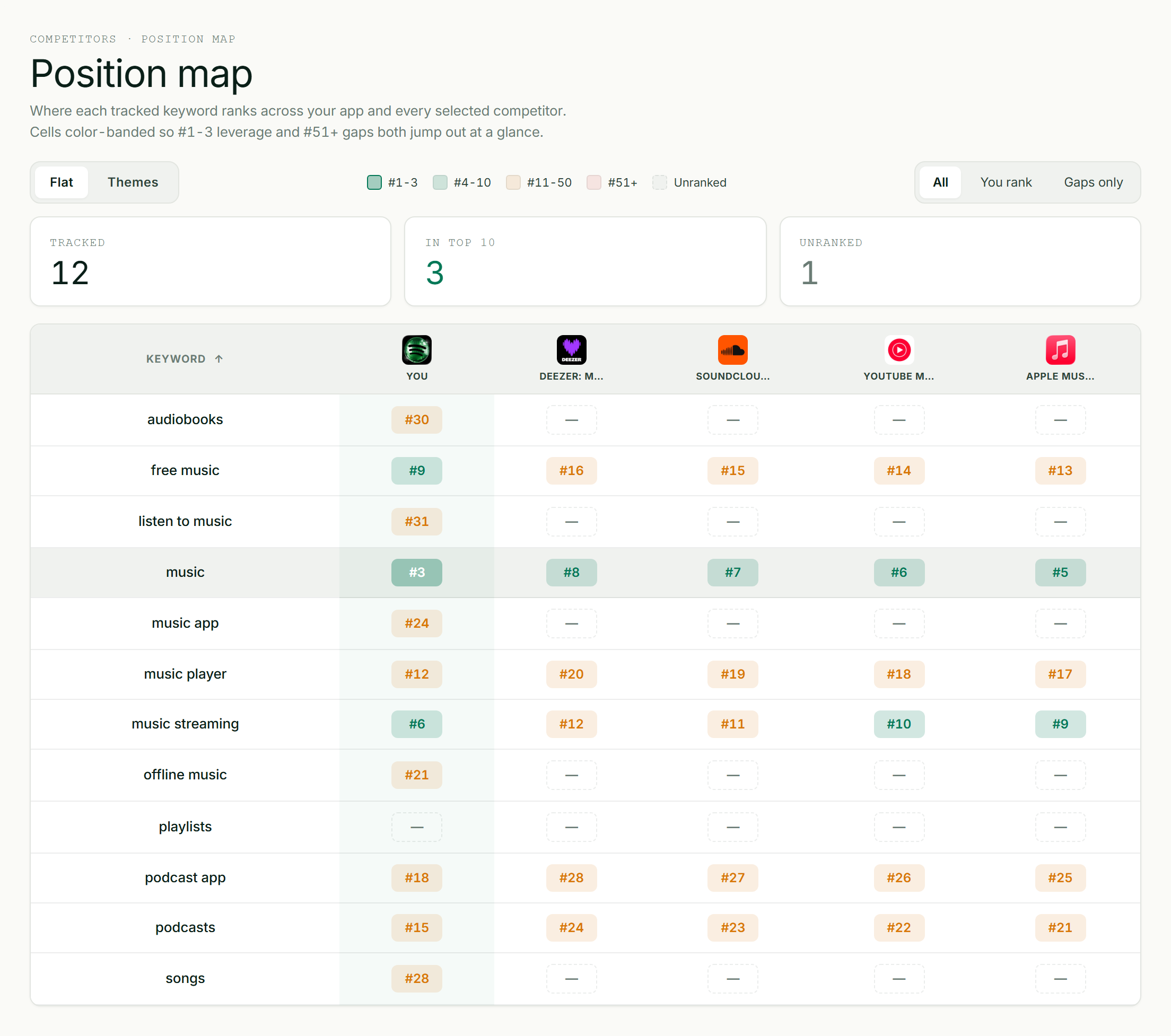
A position map of where you and each competitor rank for shared keywords.
A keyword overlap map turns this from a manual slog into a glance. ASOScan's competitor analysis builds the gap and overlap views automatically; score the gaps by volume and difficulty before you commit characters to them.
Step 3: Tear down their metadata
Read each competitor's listing like an ASO specialist:
- Title and subtitle: which keywords did they prioritize in their most valuable, limited space? That tells you what they believe converts and ranks.
- Inferred keyword strategy: the terms they rank for that aren't visible in their title/subtitle hint at what's in their (hidden) iOS keyword field.
- Description: on Google Play it's indexed, so note the keywords they repeat; on iOS it's pure positioning copy.
Step 4: Study their creatives
- Icon: how do they stand out (or blend in) in results?
- Screenshots: which benefit do they lead with on the first two or three? What captions (and now, on iOS, indexed caption keywords) are they using? See screenshots.
- Preview video: do they have one, and what story does it tell?
You're not copying; you're finding the angle they're not using that you can own.
Step 5: Ratings and velocity
- Rating and review count: a proxy for how entrenched they are. A 4.8 with 500k reviews is a different fight than a 4.1 with 2k.
- Review themes: their negative reviews are your opportunity. If users keep complaining about a competitor's missing feature, lead with it in your listing.
Step 6: Update cadence and events
- How often do they ship? Frequent updates signal an active, well-resourced competitor, and freshness is an ASO signal.
- Events and promotions: in-app events and seasonal pushes show where they invest. Patterns reveal their calendar.
Step 7: Monitor changes continuously
Competitor analysis is not a one-time audit; its biggest value is timing. When a competitor changes their title, adds a keyword, or refreshes screenshots, you want to know within hours, not when you happen to check. Set alerts on competitor metadata changes so you can react while it's fresh. ASOScan surfaces these the moment they ship, and the Browse & Discover surfaces track similar-app and featured changes too.
Common mistakes
- Copying instead of analyzing: a tactic that fits a strong incumbent can sink a newer app.
- Watching too many competitors shallowly instead of three to five deeply.
- Treating it as one-time: the highest value is catching changes as they happen.
- Ignoring competitor reviews: their complaints are your positioning.
- Chasing giants: an app that ranks for everything isn't a true peer; weight real category rivals.
Frequently asked questions
How do I do app store competitor analysis?
Identify three to five real competitors (search, category, and brand-adjacent), then compare keyword rankings to find gaps you can target, tear down their title/subtitle and creatives, check their ratings and update cadence, and monitor their listing for changes over time. The most valuable output is the keyword gap: terms they rank for that you don't yet track.
What's the most useful thing to learn from competitors?
The keyword gap: search terms your competitors rank for that you don't target yet. They're pre-validated demand in your category, and closing the gap is often the fastest visibility win available. Score each gap term by volume and difficulty before committing it to your metadata, since not every competitor keyword is winnable for your app.
Should I copy my competitor's keywords or metadata?
Use them as research, not a template. A keyword or positioning that works for a 4.8-star incumbent with millions of reviews can be unwinnable for a newer app. Read competitor listings to find demand and gaps, then choose the terms and angles that fit your app's relevance and authority.
How often should I check competitors?
Continuously for changes (ideally with automated alerts so you hear about a competitor's metadata edit within hours), plus a deeper manual teardown quarterly. The timing matters: reacting to a competitor's move while it's fresh (a new keyword, a screenshot refresh) is where competitor monitoring earns its keep.
How many competitors should I track?
Three to five, tracked deeply, beats a long list watched shallowly. Include search competitors (apps ranking for your keywords, even if functionally different), direct category rivals, and the brand-name apps users compare you to. Depth surfaces actionable gaps; breadth just generates noise.