
What Changed in ASO for 2026: New App Store & Google Play Ranking Signals
Quick answer: The biggest ASO changes for 2026 are: (1) Apple began indexing the text on your screenshots via OCR in June 2025; (2) Apple Custom Product Pages can now appear in organic search (since July 30, 2025), are keyword-assignable, and the per-app limit doubled to 70 (October 29, 2025); (3) Google Play continues to lean on custom store listings and store-listing experiments; and (4) both stores now weigh post-install engagement and retention more heavily than raw keyword match. Net effect: metadata still matters, but creative text and what users do after installing matter more than they used to.
Last updated: June 2026.
ASO is not static, and 2025 was an unusually busy year for it. If you set your App Store Optimization strategy in 2023 and haven't revisited it, several of your assumptions are now out of date. Here are the changes that actually move rankings, what's confirmed versus inferred, and what to do about each.
The short version: the ASO ranking factors that changed
- Screenshot OCR (iOS, June 2025): Apple appears to read and index the text on your screenshots. Your captions are now keyword surface.
- Custom Product Pages went organic (iOS, July 2025): CPPs can show in organic search for keywords you assign. They're no longer an ads-only tool.
- CPP limit doubled to 70 (iOS, October 2025): far more room to target segments and keyword clusters.
- Google Play custom store listings + experiments: Android's parallel toolkit for targeted, testable listings keeps expanding.
- Engagement weighting (both stores): retention and session signals carry more weight; semantic relevance is replacing exact-match keyword reliance.
Now the detail.
Change 1: Apple started indexing screenshot text (OCR)
In June 2025, the ASO community detected a significant App Store ranking shift. Appfigures called it the biggest App Store algorithm change of the year, and AppTweak's ranking-anomaly monitoring recorded an unusual spike on June 5-9, 2025. The explanation that fit the data: Apple began using OCR (optical character recognition) to read the text rendered on app screenshots and use it as a search-relevance signal.
A precise framing matters here, because credibility is the whole game with this audience: Apple has not formally documented this in its developer guidance. The evidence is strong but circumstantial: measured ranking anomalies plus pattern analysis across many apps, not an Apple announcement. Treat it as a well-supported working assumption, not gospel.
What to do about it:
- Put real, relevant keywords into your screenshot captions, the short text overlays, especially near the top and bottom where captions usually live.
- Keep captions readable and benefit-led first. You're writing for humans who decide whether to install; the keyword value is a bonus, not a license to stuff text.
- Audit competitors' captions for terms they're now effectively indexing that you're missing.
This change quietly made the screenshot the rare asset that drives both conversion and (now) keyword relevance. It deserves more attention than most teams give it.
Change 2: Custom Product Pages became an organic ASO tool
Apple Custom Product Pages (CPPs) are alternate versions of your product page (different screenshots, preview videos, and promotional text) while your app name, subtitle, icon, and description stay the same. Until 2025 they were essentially an Apple Search Ads and deep-link tool: you could only drive traffic to them with a direct link or a paid campaign.
That changed in 2025, and it's a genuinely new organic surface:
| What changed | Detail | Date |
|---|---|---|
| CPPs appear in organic search | A CPP can replace your default page in organic results for assigned keywords | July 30, 2025 |
| Keyword assignment | You assign keywords (from your keyword field) to a CPP in App Store Connect | Mid-2025 |
| Per-app limit doubled | From 35 to 70 Custom Product Pages per app | October 29, 2025 |
The rules are specific, per AppTweak's CPP guide: you can only assign keywords that live in your keyword field (not your title or subtitle), and each keyword combination can map to only one page. Each CPP supports up to 10 screenshots, 3 preview videos, 170 characters of promotional text, and up to 3 localizations.
What to do about it:
- Treat your iOS keyword field as the supply that feeds CPP targeting: it's the only field you can assign from.
- Build CPPs around distinct search intents. If you rank for both "meditation" and "sleep sounds," a CPP whose screenshots lead with sleep can convert the sleep searchers better than a generic page.
- Measure conversion per CPP and keep the winners. Apple reports meaningful average conversion lifts from CPPs, though, as always, treat a vendor's average as a ceiling to aim at, not a promise.
Change 3: Google Play's targeted, testable listings
Android's parallel toolkit is Custom Store Listings (CSLs) and Store Listing Experiments. Unlike Apple's CPPs, Google Play's custom listings can be triggered organically by signals like the user's country, install state (new vs. returning), or even the search keyword, giving broader reach than Apple historically allowed.
On testing, the two stores differ in a way worth knowing:
- Google Play Store Listing Experiments let you A/B test the icon, screenshots, descriptions, feature graphic, and preview video. You can run a handful of experiments on your main listing, and custom store listings unlock many more variants to test against segments.
- Apple Product Page Optimization lets you test up to three variants of your icon, screenshots, and preview against the default.
What to do about it: run experiments continuously, one hypothesis at a time, and let each reach statistical significance before you call it. Guessing at creative is the most expensive habit in ASO.
Change 4: Engagement and retention now carry more weight
The throughline across 2025-2026, reported consistently across the ASO industry, is that both Apple and Google shifted weight away from pre-install signals (exact keyword match, raw download counts) toward post-install signals (retention curves, session frequency, engagement depth) and toward semantic relevance, where the algorithm infers what your app is about from context rather than matching strings literally.
The practical implication is uncomfortable but fair: a keyword-perfect listing with weak retention will lose to a slightly less optimized app that keeps its users. ASO is no longer only a metadata exercise; it's increasingly tied to whether your app is actually good.
What to do about it:
- Keep optimizing metadata: it still decides which searches you're eligible for.
- Watch your retention and engagement, because they now influence whether you hold the rankings you earn.
- Use review sentiment to find the friction that drives users away. ASOScan's review analytics surfaces the themes behind your ratings so you can fix what's actually losing users.
Your 2026 ASO action list
If you do nothing else this quarter:
- Add keywords to your screenshot captions (and keep them readable).
- Audit your iOS keyword field so it can feed CPP targeting (see the keyword field guide).
- Spin up one or two intent-based Custom Product Pages and measure them.
- Run a creative experiment on both stores, one variable at a time.
- Check your retention and review sentiment: the algorithm is watching them now.
- Re-localize for your top markets, since per-market keyword research compounds with everything above. ASOScan's multi-country tracking makes that practical across storefronts.
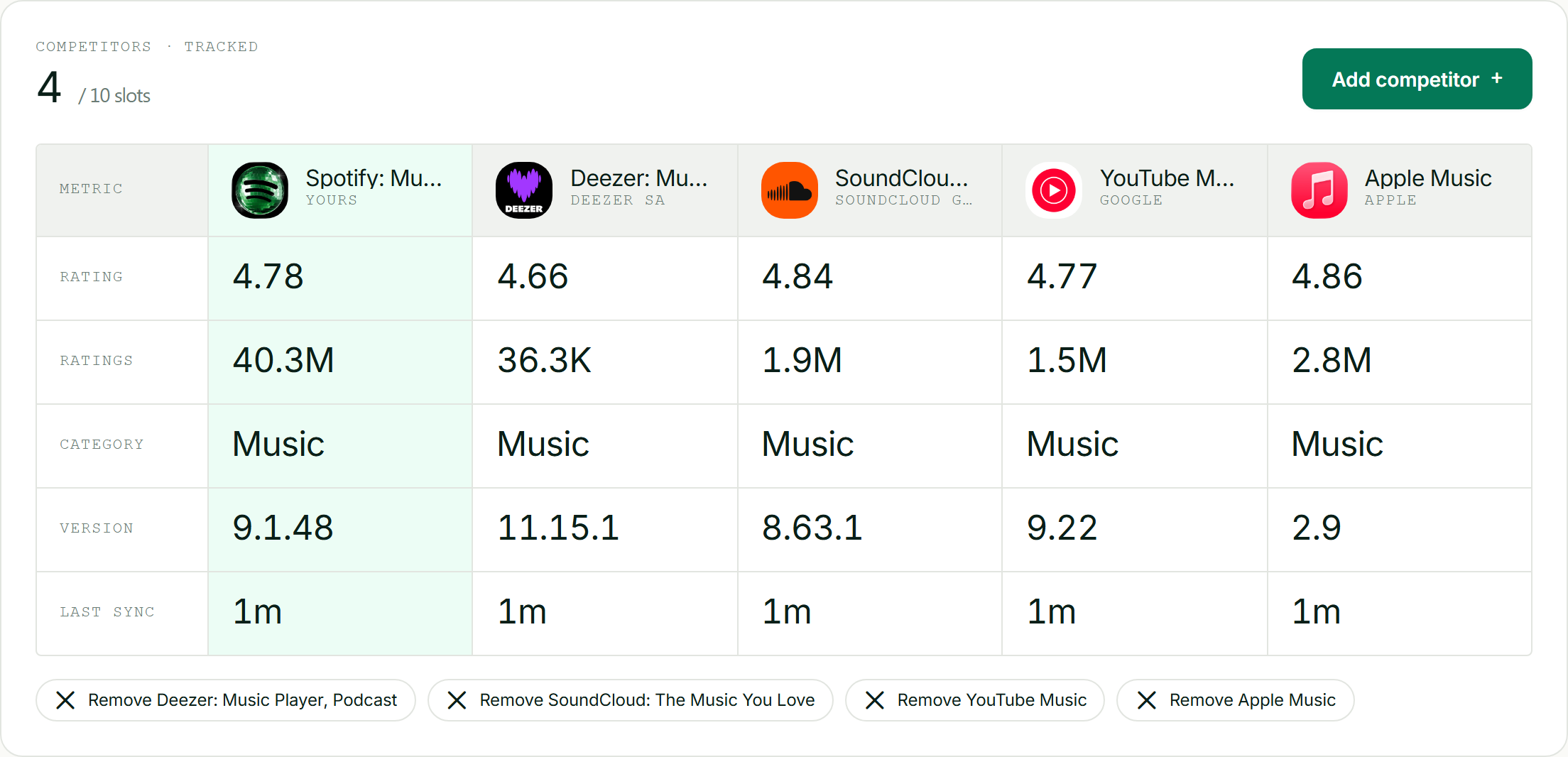
Side-by-side competitor metadata, so you see changes the moment they ship.
Frequently asked questions
Does Apple really index screenshot text now?
Strong evidence says yes. Starting around June 2025, ranking-anomaly data from Appfigures and AppTweak pointed to Apple using OCR to read and index screenshot caption text as a relevance signal. Apple has not formally documented it, so treat it as a well-supported working assumption and write relevant, readable captions accordingly.
How many Custom Product Pages can I have in 2026?
Up to 70 per app, doubled from 35 on October 29, 2025. Since July 30, 2025, CPPs can also appear in organic search results for keywords you assign to them from your keyword field, making them an organic ASO tool, not just an Apple Search Ads one.
What's the difference between Apple CPPs and Google Play custom store listings?
Apple CPPs historically required a direct link or ad to reach, and only gained organic search visibility in July 2025. Google Play custom store listings can be triggered organically by signals like country, install state, or keyword. Both let you tailor creative to a segment; Google's organic triggers are broader.
Are keywords still important for ASO in 2026?
Yes. Keyword optimization still decides which searches your app is eligible to appear for, and it remains the foundation of ASO. What changed is that creative text (screenshot captions) and post-install behavior (retention, engagement) now carry more weight on top of keywords. Metadata is necessary; it's just no longer sufficient on its own.
How do I keep up with App Store and Play Store changes?
Monitor your own keyword rankings daily (algorithm shifts show up there first as anomalies) and track competitor metadata changes so you see new tactics as they're deployed. ASOScan's competitor analysis and ASO score trends are built for exactly this kind of monitoring.
For the full picture behind these factors, read the complete ASO guide and how app store ranking works.