
App Store Keyword Research: How to Find Keywords That Convert
Quick answer: App store keyword research is the process of finding the search terms your future users type into the App Store and Google Play, then choosing the ones worth targeting based on three numbers: search volume (demand), difficulty (competition), and relevance (intent match). The goal is not the highest-volume keywords; it's the highest-opportunity ones, which are usually relevant, winnable long-tail phrases.
Last updated: June 2026.
Keyword research is the foundation of App Store Optimization. Get it right and every other ASO decision (what to put in your title, which markets to prioritize, what your competitors are quietly winning) falls into place. Get it wrong and you can do everything else perfectly while ranking for terms nobody searches.
This guide is the practical, repeatable process: where keywords come from, how to evaluate them, how iOS and Android research differ, and the mistakes that waste the most time.
What is app store keyword research?
App store keyword research is the work of building and prioritizing a list of search terms to target in your app's metadata. Unlike web SEO, you are not researching for a blog post; you are deciding which terms earn a place in a tiny, fixed amount of indexable space (30 characters of title, 30 of subtitle, 100 in the iOS keyword field). Every keyword you target costs you characters, so the bar is high.
A finished keyword list answers one question for every term: is this worth the characters? That depends on three metrics.
The three metrics that matter
| Metric | What it measures | What "good" looks like |
|---|---|---|
| Search volume | How many people search the term | High enough to matter, but volume alone is a trap |
| Difficulty | How hard it is to rank against current competitors | Low-to-moderate for a new or smaller app |
| Relevance | How well the term matches what your app actually does | High: irrelevant traffic doesn't convert or retain |
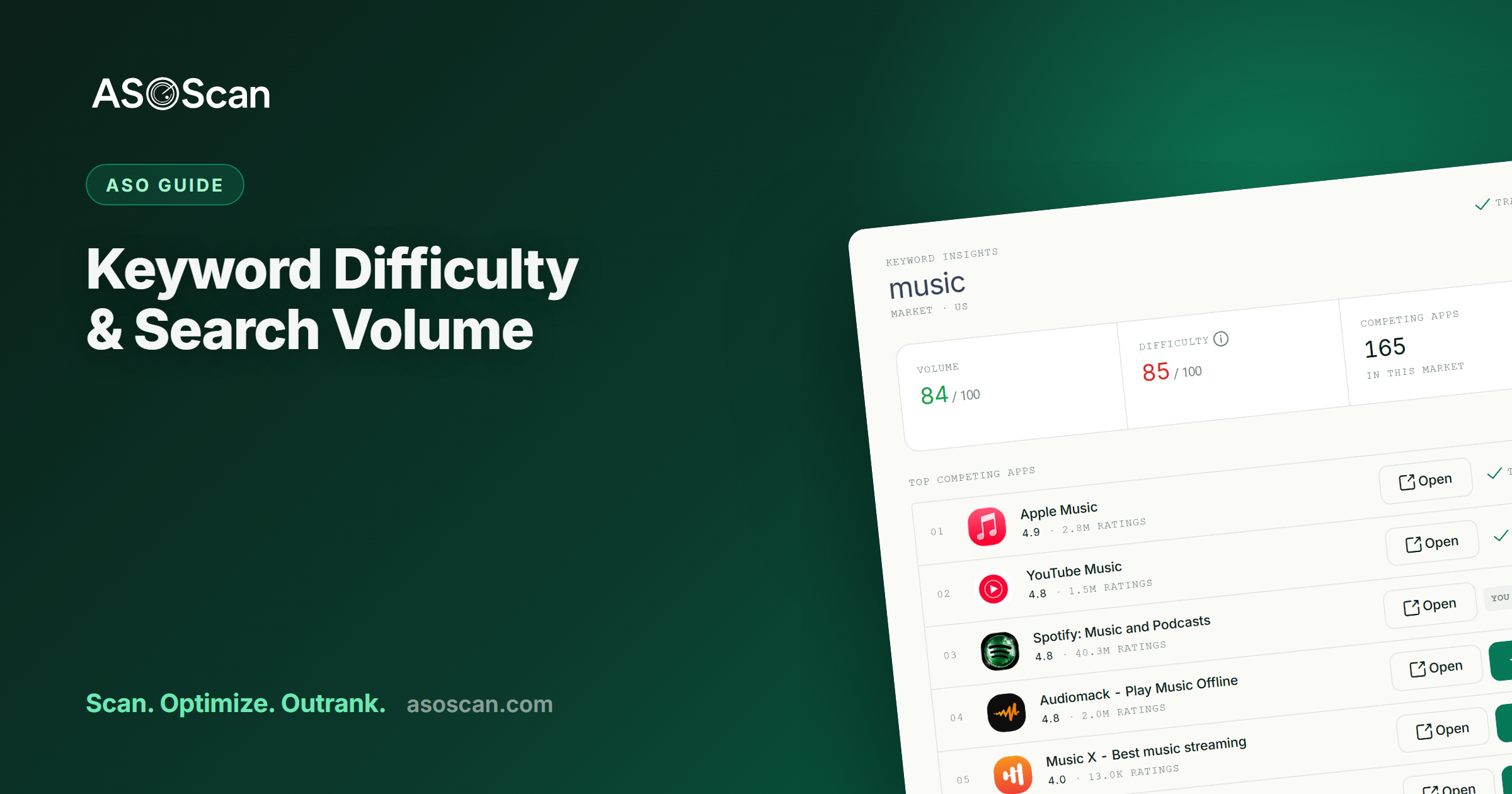
The art is balancing them. A term with huge volume and crushing difficulty is a long-term aspiration, not a launch target. A perfectly relevant term with near-zero volume isn't worth a character. The sweet spot (the opportunity quadrant) is relevant terms with real demand and difficulty you can actually beat. We break down exactly how these two numbers are calculated (and why you should be skeptical of any tool that won't tell you) in keyword difficulty and search volume, explained.
Where good keyword candidates come from
Strong keyword lists are not invented at a whiteboard; they are mined from six sources. Most teams use one or two and miss the rest.
- Your own metadata. The terms already in your title, subtitle, and description are your starting seeds. Expand from them.
- Your competitors. The keywords competitors rank for (especially the ones you don't track yet) are the richest vein in ASO. If three rivals all rank for a term and you don't, that's a gap.
- Autocomplete (store + Google Suggest). Type a seed term and read what the store suggests. Those suggestions are real queries, ordered by popularity.
- AI suggestions. A language model primed with your app's category and value proposition surfaces phrasings you wouldn't think of, especially synonyms and intent variations.
- Store data and related terms. The "related searches" and category associations the stores expose are validated, real-user signals.
- Category and trend data. What's rising in your category, per market, tells you where demand is moving before it peaks.
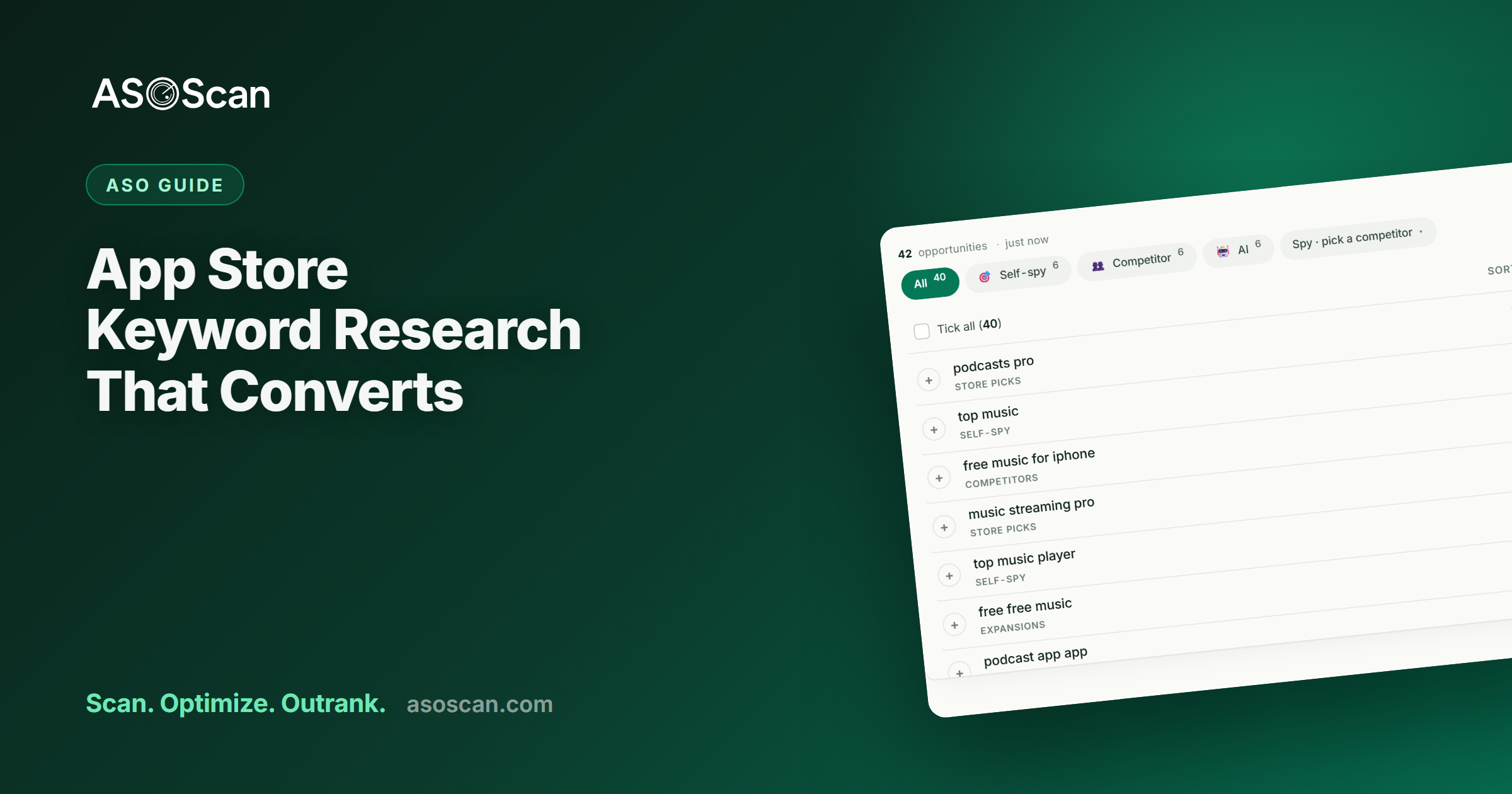
Doing all six by hand, per market, every week, is not realistic. ASOScan's keyword intelligence runs all six sources continuously and ranks the candidates into one list with an opportunity score, so the discovery step is already done when you sit down to work.
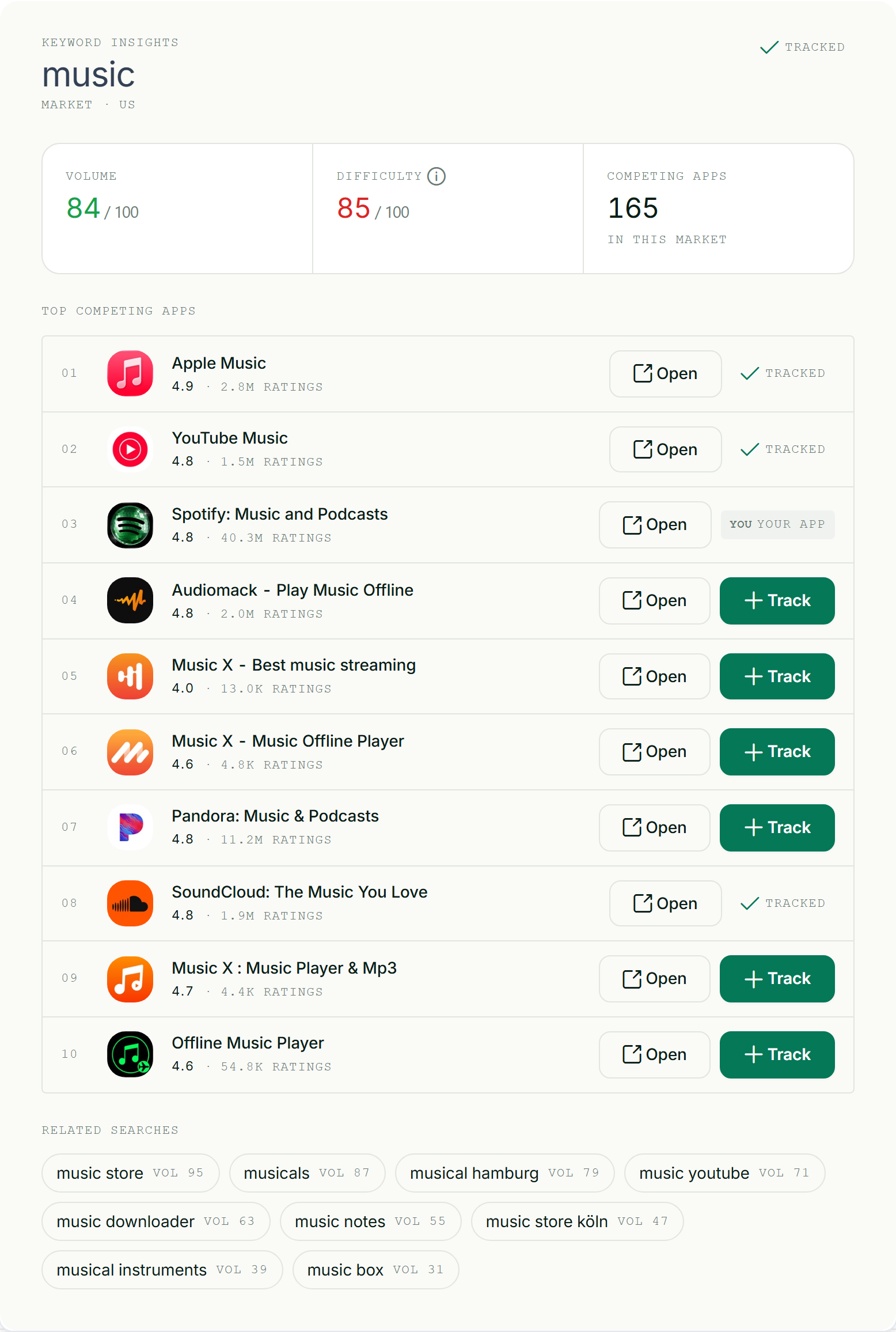
Volume, difficulty, and the competing apps behind a single keyword.
A repeatable keyword research process
Here is the process, start to finish.
- Define the app in one sentence. "A habit tracker for people building a morning routine." This forces relevance discipline: every keyword is judged against it.
- Gather seed terms from your own metadata and your one-sentence definition.
- Pull competitor keywords. List your three to five closest competitors and collect the terms they rank for. Flag the ones you don't already target.
- Expand with autocomplete and AI. Run each seed through store autocomplete and an AI pass to generate variations and long-tail phrases.
- Add volume and difficulty to every candidate, per market.
- Score and sort. Rank by opportunity (high relevance × meaningful volume ÷ difficulty). Prioritize long-tail terms you can win now over head terms you can't.
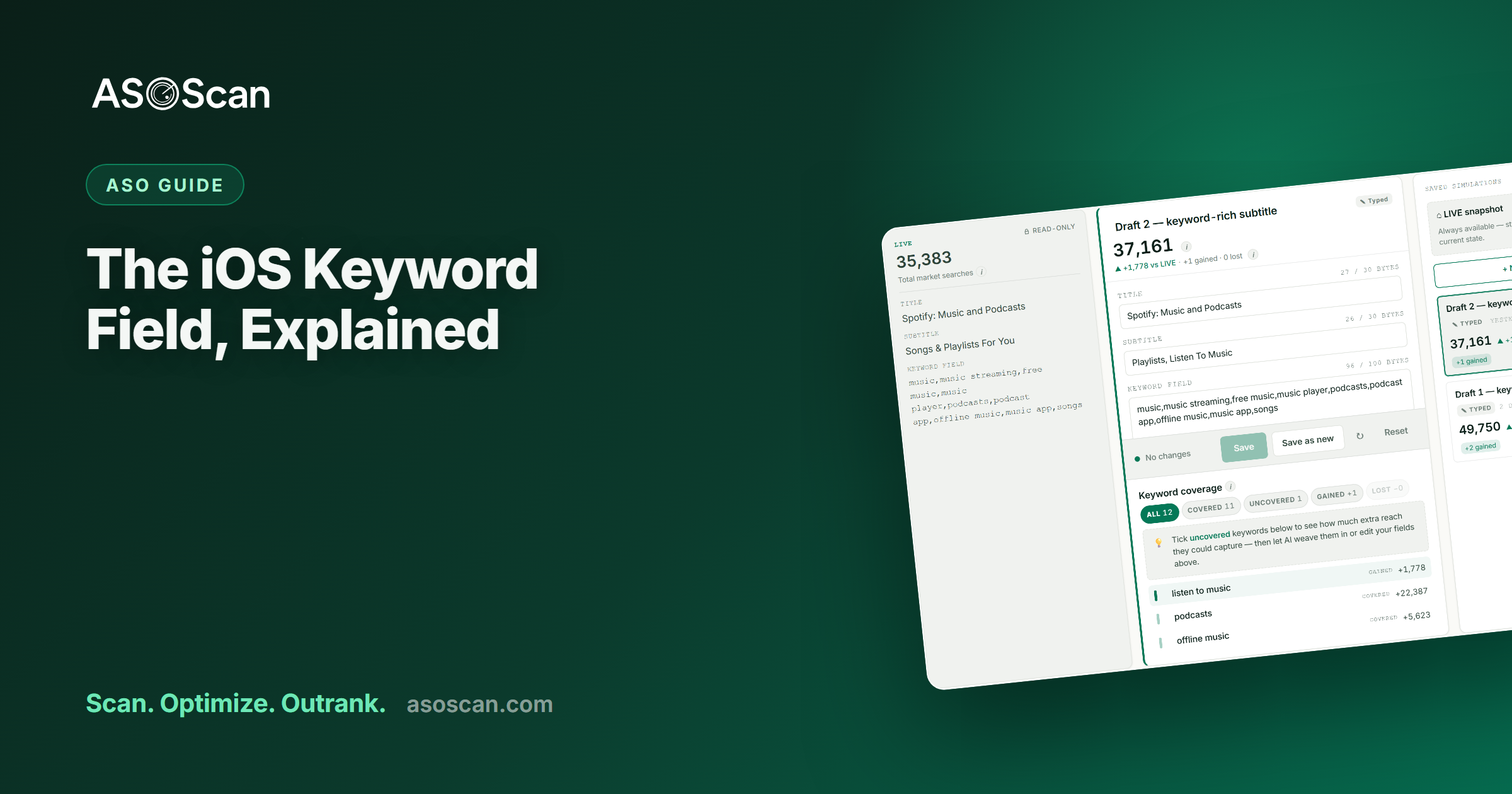
- Map keywords to fields. Decide which terms go in the title, subtitle, iOS keyword field, or Google Play descriptions. (See the iOS keyword field guide for the placement rules.)
- Track and revisit. Rankings, volume, and competitors all move. Re-run monthly at minimum; track your priority terms daily.
iOS vs Android: research differs by platform
The metrics are the same, but where the keywords go is not, and that changes what's worth researching.
| Apple App Store | Google Play | |
|---|---|---|
| Hidden keyword field | Yes: 100 characters of pure, user-invisible keyword space | No |
| Description indexed | No: research only for title, subtitle, keyword field | Yes: the 4,000-character description ranks too |
| Keyword combinations | Apple combines words across fields, so you don't repeat | Repetition (natural) in the description carries weight |
| Search-volume data | No official organic volume; estimated from multiple signals | More signal available, but still no perfect public source |
The honest version: no tool has perfect search-volume data, and iOS organic volume in particular is an estimate built from multiple signals, because Apple does not publish it. Treat every volume number, from us or anyone, as directional, and validate your most important terms against your own knowledge and your App Store Connect / Play Console data.
Long-tail keywords: the strategy that actually works for smaller apps
If your app is new or mid-sized, chasing head terms is a losing game. The winning move is long-tail.
- Lower competition. Fewer apps fight for "meal planner for diabetics" than for "meal planner."
- Higher intent. A long query means the searcher knows exactly what they want. They convert better.
- Compounding coverage. Twenty long-tail terms you actually rank for beat one head term you rank #40 for.
As your app earns installs and ratings on long-tail terms, your authority grows and the head terms become reachable. Long-tail is how you climb, not where you stay.
Common keyword research mistakes
- Chasing volume over relevance. A high-volume term that doesn't match your app brings traffic that bounces, and the store notices the weak conversion.
- Ignoring competitors. Your competitors have already done expensive research. Reading their rankings is the cheapest research you'll ever do.
- Repeating keywords on iOS. Apple combines words across your title, subtitle, and keyword field. Repeating a word wastes characters you could spend on a new term.
- Translating instead of researching. Running your English list through a translator for a German or Japanese market gives you words nobody searches. Research each market natively.
- Researching once. Rankings and demand drift. A list you built six months ago is already stale.
Frequently asked questions
How many keywords should I target?
Target every term you can fit credibly into your indexable fields: roughly 20-40 distinct, relevant terms across your title, subtitle, and (on iOS) the keyword field, per market. Quality and fit matter more than count: a focused list of winnable, relevant terms beats a padded list of aspirational ones.
What's the difference between search volume and keyword difficulty?
Search volume estimates how many people search a term; keyword difficulty estimates how hard it is to rank for it against the current competitors. You want terms with enough volume to matter and low enough difficulty to win. We explain both in detail in keyword difficulty and search volume, explained.
Can I just copy my competitor's keywords?
Reading competitor keywords is smart research; copying their metadata wholesale is not. Use their rankings to find gaps and validate demand, then choose the terms that fit your app's relevance and authority. A keyword that works for a 4.8-star incumbent may be unwinnable for a new app.
How often should I redo keyword research?
Do a full refresh monthly, and track your priority keywords daily so you catch ranking drops, competitor moves, and seasonal shifts as they happen. ASO is a moving target.
Do I need a paid tool for keyword research?
For one app in one market, store autocomplete plus a spreadsheet can get you started. For multiple apps, multiple markets, competitor tracking, and daily rank monitoring, a dedicated tool quickly pays for itself. The free ASO scan is a no-signup way to see the kind of data a tool surfaces.
This post is part of our keywords series: start with the complete app store keywords guide, how keyword difficulty and search volume work and track your keywords 200 positions deep.