ASO vs Apple Search Ads: Organic vs Paid App Discovery
Quick answer: ASO (App Store Optimization) is the organic side of App Store growth: optimizing your listing so you rank and convert for free. Apple Search Ads (now branded Apple Ads) is the paid side: bidding to place your app at the top of search results and other slots. They're complementary, not competing: strong ASO makes your ads cheaper because your metadata sets your ad's relevancy, and paid installs can help jump-start your organic rankings. The right order is ASO first, paid layered on top strategically.
Last updated: June 2026.
"Should I do ASO or run Apple Search Ads?" is the wrong question: the answer is almost always both, in the right order. They pull the same lever (App Store visibility) from two directions, and they make each other work better. This guide explains exactly how each one works, where they overlap, the trap that wastes the most ad budget, and how to sequence them. It builds on the App Store Optimization guide.
ASO vs Apple Ads in one line
- ASO earns visibility by making your listing relevant and high-converting. You don't pay per install; the work compounds.
- Apple Ads buys visibility by winning an auction for ad placements. You pay per tap; it stops the moment the budget does.
What Apple Ads (Apple Search Ads) is
Apple Ads places your app in paid slots across the App Store. There are four placements:
- Search Results: the top of the results for a keyword you bid on. Highest intent, strongest for installs.
- Search Tab: before the user even types, on the Search screen.
- Today Tab: the App Store homepage, for awareness and reach.
- Product Pages: in the "You Might Also Like" area of other apps' pages (competitor interception).
It runs on a cost-per-tap (CPT), second-price auction: you set a max bid, and you pay just above the next-highest bidder, never more than your max. CPT varies a lot by market and category: the US median is roughly $1.58, with competitive categories averaging $2+ and some niches $3+, per Business of Apps benchmarks.
There are two tiers: Basic (automated, capped around $10,000/month per app) and Advanced (full keyword-level control).
New for 2026: Apple is expanding the number of ad positions in search results: slots #2-#5 are opening up from March 2026, where previously the prime real estate was essentially the single top slot (reported here). More paid inventory means more competition for the top of the page, which raises the value of organic placement below it.
What ASO is (the organic engine)
ASO is everything covered across this blog: keyword research, the iOS keyword field, screenshots, ratings, and localization. It's how you appear and convert in organic search and browse, the results users see for free.
The crucial difference: paid stops, organic compounds
| ASO (organic) | Apple Ads (paid) | |
|---|---|---|
| Cost model | Time/effort, paid once per change | Cost per tap, every tap, forever |
| When it stops | Keeps working after the work is done | Stops the moment the budget ends |
| Speed | Days to weeks to move rankings | Instant placement |
| Targeting | Everyone searching your terms | Exactly the keywords you bid on |
| Compounding | Yes: rankings + ratings build on each other | No: flat spend-to-installs |
Paid is a tap you turn on and off; organic is an asset you build. That's why "do ASO first" isn't a preference. It's the better unit economics.
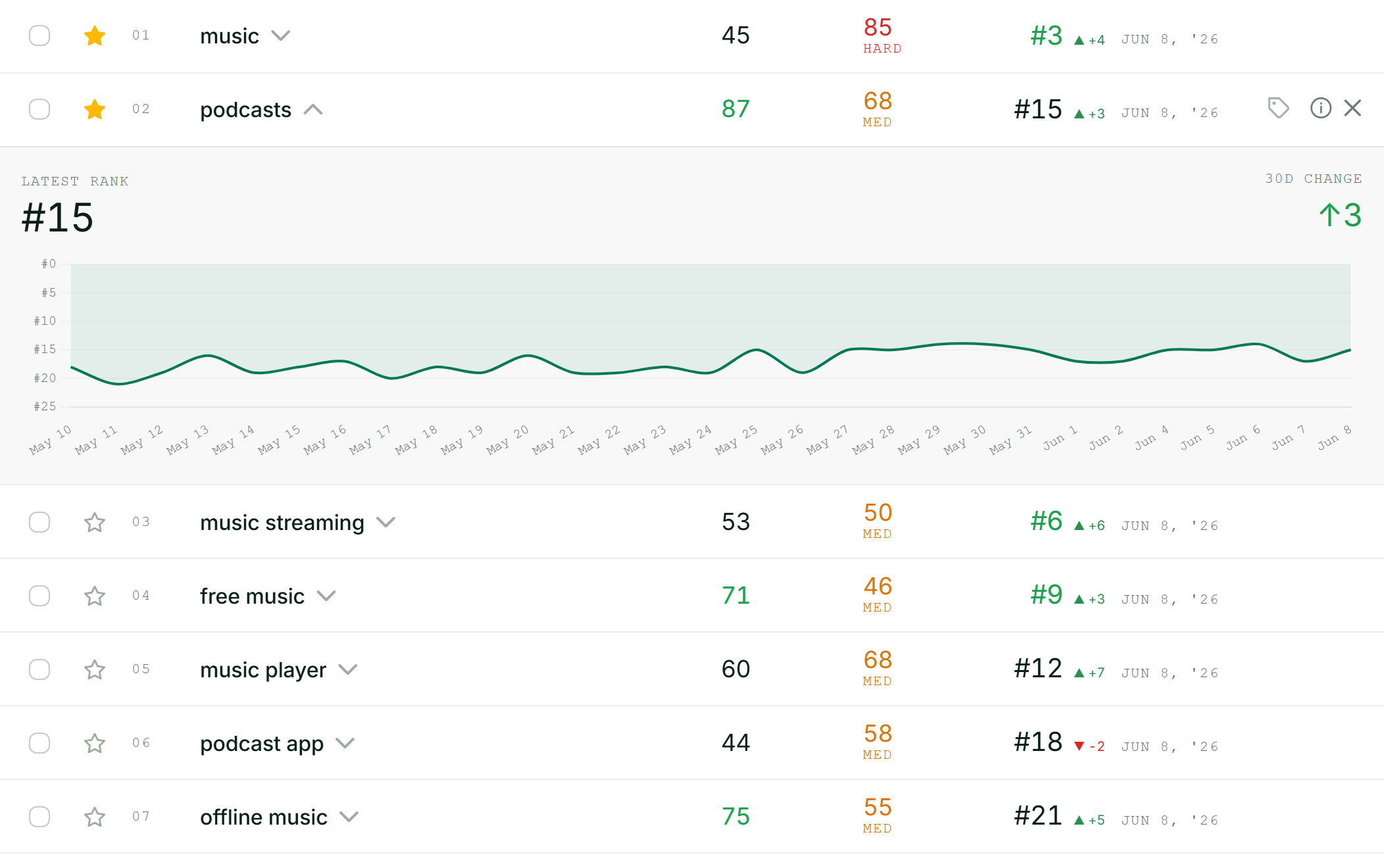
Organic rank, tracked over time: the asset Apple Ads can jump-start but never replace.
They're synergistic, not either/or
The two systems feed each other:
- Your metadata sets your ad relevancy. Apple uses your listing to decide whether your ad is relevant to a keyword. A well-optimized listing earns a better relevancy score, which lowers your effective CPT. Bad ASO literally makes your ads more expensive.
- Paid installs can jump-start organic rank. Downloads and engagement are ranking signals, so driving installs to a keyword with Apple Ads can help establish your app's relevance for that term organically: a "jump-start" for a keyword you're trying to break into (SplitMetrics). It's a nudge, not a guarantee; sustained organic rank still depends on conversion and retention.
So the loop is: ASO makes ads cheaper → ads jump-start new keywords → those keywords build organic rank → organic rank reduces what you need to spend.
The cannibalization trap
The most common Apple Ads mistake is paying for traffic you already own. If you rank #1 organically for your brand name or a core term, bidding on it can mean paying for taps you'd have gotten for free. Before you bid on a keyword, check whether you already rank for it organically. That's exactly the kind of thing you can see in keyword intelligence. Spend your budget on terms you can't yet win organically, not the ones you already dominate.
When to use which
- Lead with ASO for every app, always: it's the foundation and the cheaper long-term channel.
- Add Apple Ads to: enter competitive keywords you can't rank for organically yet, capture high-intent terms while your organic rank climbs, defend your brand term against competitor bids, and intercept competitors on their product pages.
- Use the data both ways: the keywords that convert in Apple Ads are proven demand. Feed them back into your organic keyword research.
ASOScan is built around the organic side (your ASO command center) and the Ad Campaigns tools help you act on the paid side from the same place. We won't pretend a paid dashboard replaces organic ASO; the point is to make both decisions from one set of keyword data.
Frequently asked questions
Is ASO better than Apple Search Ads?
Neither is "better". They do different jobs. ASO builds organic visibility that compounds and costs nothing per install; Apple Ads buys instant placement that stops when the budget does. For sustainable, efficient growth, ASO is the foundation, with Apple Ads layered on top for speed, competitive keywords, and brand defense. The best programs run both and share data between them.
Does running Apple Search Ads help organic rankings?
It can, indirectly. Downloads and engagement are App Store ranking signals, so driving installs to a keyword via Apple Ads can help establish your relevance for that term and jump-start organic rank, especially for a keyword you're trying to break into. It's a nudge, not a guarantee; holding the rank still depends on conversion and retention.
How much does Apple Search Ads cost?
You pay per tap (CPT) via a second-price auction, so you pay just above the next bid, capped at your max. Costs vary widely: the US median CPT is around $1.58, with competitive categories averaging $2+ and some niches $3+. Better ASO improves your ad relevancy, which lowers your effective CPT.
Should I bid on keywords I already rank for organically?
Usually not on the ones you already dominate: that's cannibalization, paying for taps you'd get for free. Bidding can make sense to defend a brand term against competitors or to reinforce a keyword you rank for but don't yet own. Spend most of your budget on high-intent terms you can't rank for organically yet.
Do I need Apple Ads if my ASO is good?
No. Strong ASO can carry an app on its own, and many apps grow profitably with zero paid spend. Apple Ads is an accelerant: useful for breaking into competitive keywords faster, capturing high-intent demand, and defending your brand. Get ASO right first; add paid when you have a clear, measurable reason to.
See how ASOScan handles the paid side: Apple Search Ads from your ASO keywords and ad campaigns built on tracked keywords.