
App Localization: A Practical Guide for App Store & Google Play
App localization is the process of adapting a mobile app, and its App Store or Google Play listing, so it feels native to users in a specific language and region. That covers translated text plus the right currency, date format, imagery, and sometimes a different feature set for that market. Done well, it lets people discover, understand, and trust your app in their own language before they ever open it.
If you want to see how localization plugs into keyword strategy across multiple stores, read our App Localization & Multi-Market ASO: A Practical Guide. This page covers the broader process: what localization involves, how it differs from translation, the steps to run it, and how to test and measure it.
What is app localization and why does it matter?
App localization means adapting an app's interface, content, and store listing so it functions and reads naturally for users in a given locale, a combination of language and region (like es-MX vs es-ES, or en-GB vs en-US). It covers UI text, number formats, currency, legal text, images, and sometimes entire features.
It matters because most App Store and Google Play traffic is search-driven, and search happens in the user's own language. A US-English-only listing shown to a searcher in Mexico City or Tokyo doesn't match what they typed. Apple's developer documentation on localization exists because supporting additional languages is one of the more direct ways to reach users you'd otherwise never surface for (Apple, Localization). On Android, Google's resource system is built around the same idea: an app ships multiple values-<locale> folders so the OS picks the right strings automatically (Android Developers, Localize your app).
App localization vs. translation: key differences
Translation converts words from one language to another. Localization adapts the whole experience to a place. A translated app might say "11/03/2026" when it means November 3rd, because it kept the US date format; a localized app for the UK or France shows "03/11/2026" or "3 nov. 2026" instead. A translated fitness app might still show distances in miles for a German user; a localized one switches to kilometers by default.
Localization also touches things translation never does: color and imagery that carry different meaning by culture, payment methods people actually use locally (a US app assuming credit cards will struggle in markets where mobile wallets dominate), legal disclosures required by local regulation, and which features are relevant at all. Translation is a subset of localization, not a substitute for it.
How app localization works: a step-by-step process
- Pick your markets deliberately. Don't localize everywhere at once. Start with markets where you already have organic traffic, paid traffic, or clear demand signals (category performance, competitor presence, or existing non-English installs).
- Extract and externalize strings. Every user-facing string in the app needs to live outside hard-coded source, in resource files (
Localizable.stringson iOS,strings.xmlpervalues-<locale>folder on Android) so a translator or localization tool can work on them without touching code. - Translate with context, not word lists. Send translators screenshots or the actual UI, not a spreadsheet of isolated strings. A button label 6 characters wide in English can double in length in German.
- Localize non-text elements. Adapt screenshots, dates, currency, units, and culturally specific imagery per locale.
- Localize the store listing separately. This is metadata work, distinct from in-app strings, and it's where most of the discoverability gain actually happens (more below).
- QA in-context. Run the localized build on real devices with the target locale set, not a translation review in a spreadsheet.
- Ship, then monitor. Track conversion rate and keyword visibility per locale after launch, not once.
Step 5 deserves its own keyword pass. Even within one market, search terms don't behave uniformly. In the US, the term "app store optimization" carries a difficulty of 50 out of 100, while a related term like "app store optimization tools" sits at only 14 out of 100 with 60 monthly searches. That kind of spread exists inside every locale, which is exactly why you run a fresh keyword pass per market rather than machine-translating a US keyword list. Our app store keywords guide covers how to build that list properly.
Key elements to localize (and which store they apply to)
Some of what you localize is shared across both stores. Some is store-specific, and mixing the two produces advice that's wrong on one platform. Here's the split.
Shared across both stores:
- UI strings: buttons, labels, error messages, onboarding copy.
- Media: screenshots and preview videos with localized text overlays, not just the underlying screens.
- Formats: dates, times, currency, number separators (1,000.50 vs 1.000,50), and units of measurement.
- Legal and compliance content: privacy policy links, terms, and region-specific disclosures.
- Support: in-app help content and customer support channels in the local language, where feasible.
App Store (iOS) metadata: localize the app name, subtitle, promotional text, the visible description, and the separate hidden keyword field, each per locale. The keyword field and subtitle are iOS-only concepts; they don't exist on Google Play.
Google Play (Android) metadata: localize the title, short description, and full description per language. There is no hidden keyword field, so your indexable keywords have to live inside copy a human reads.
Skipping any of these creates a visible seam. A screenshot still in English inside an otherwise-localized German listing reads as an afterthought, and users notice.
App Store localization: how each store actually handles it
The App Store and Google Play index localized metadata differently, and conflating the two produces advice that fails on at least one platform.
On the App Store (iOS)
Apple lets you add localized values in App Store Connect for the app name, subtitle, promotional text, description, and a separate keyword field per locale. Apple's App Store search combines the app name, subtitle, and that keyword field to build the phrases it matches against a query, so repeating a word already in your name or subtitle inside the keyword field wastes space rather than adding reach (Apple, App Store search). The visible long description is not indexed for search on iOS, so write it as a conversion asset.
On Google Play (Android)
Google Play has no hidden keyword field. The title, short description, and full description are the indexed text for that locale, so keywords need to sit naturally inside copy a human would actually read; Google treats obvious keyword stuffing as a policy violation. Google Play Console supports a separate store listing per language, each with its own title, descriptions, graphics, and screenshots, using the same locale-based resource model Android uses for in-app strings (Android Developers, Localize your app).
Where they agree: both stores let you localize screenshots and graphics per locale, both benefit from a full re-optimization (not a straight translation) of the listing per market, and both count screenshot text as the first thing users read.
Best practices for app localization
Work with in-market reviewers, not only translators. A native speaker who's never used your product category will translate correctly but miss tone. A translator with no local context will miss idiom. The best results come from a translator briefed on the product plus a local reviewer checking the finished screens in-app.
Localize screenshots with real, translated UI text. Overlaying a translated caption under an English screenshot fools nobody. Users judge a listing by what's visually on the screenshot in the first two seconds.
Don't localize into a market you can't support. Adding Japanese metadata without a plan for Japanese customer support or payment methods creates downloads you can't retain. Our guide on how to increase app downloads shows how localization fits into a broader acquisition plan rather than standing alone.
Common app localization challenges and how to overcome them
Text expansion breaking layouts. German, Finnish, and Russian strings often run noticeably longer than their English source, which can push a button label or a header past the width it was designed for. Build UI with flexible-width containers from the start rather than retrofitting after localization reveals the problem.
Machine-translated keyword lists that miss real local search behavior. A direct translation of an English keyword often isn't what a local searcher types; slang, compound words, and category naming conventions vary by market. This is the single biggest reason localized listings underperform even when the translation itself is grammatically correct. ASOScan's multi-country keyword research is built for exactly this: it surfaces the best-performing keywords for each country so you localize metadata around real per-market search behavior instead of a translated list.
Inconsistent terminology across screens. Without a shared glossary, "Sign in" on one screen and "Log in" on another (translated by different people) reads as sloppy. A translation memory or style guide fixes this once and keeps paying off on every update.
RTL layout issues. Arabic and Hebrew need right-to-left layout support, not only translated strings. That's a development task, and it's easy to underestimate the engineering time it takes.
Tools and platforms for app localization
| Category | What it's for | Notes |
|---|---|---|
| Translation management systems | Managing strings, translators, and review workflows | Handle string extraction, in-context screenshots, and translation memory |
| Native localization files | iOS .strings / Android values-<locale> |
Built into each platform's SDK, required regardless of what TMS you use |
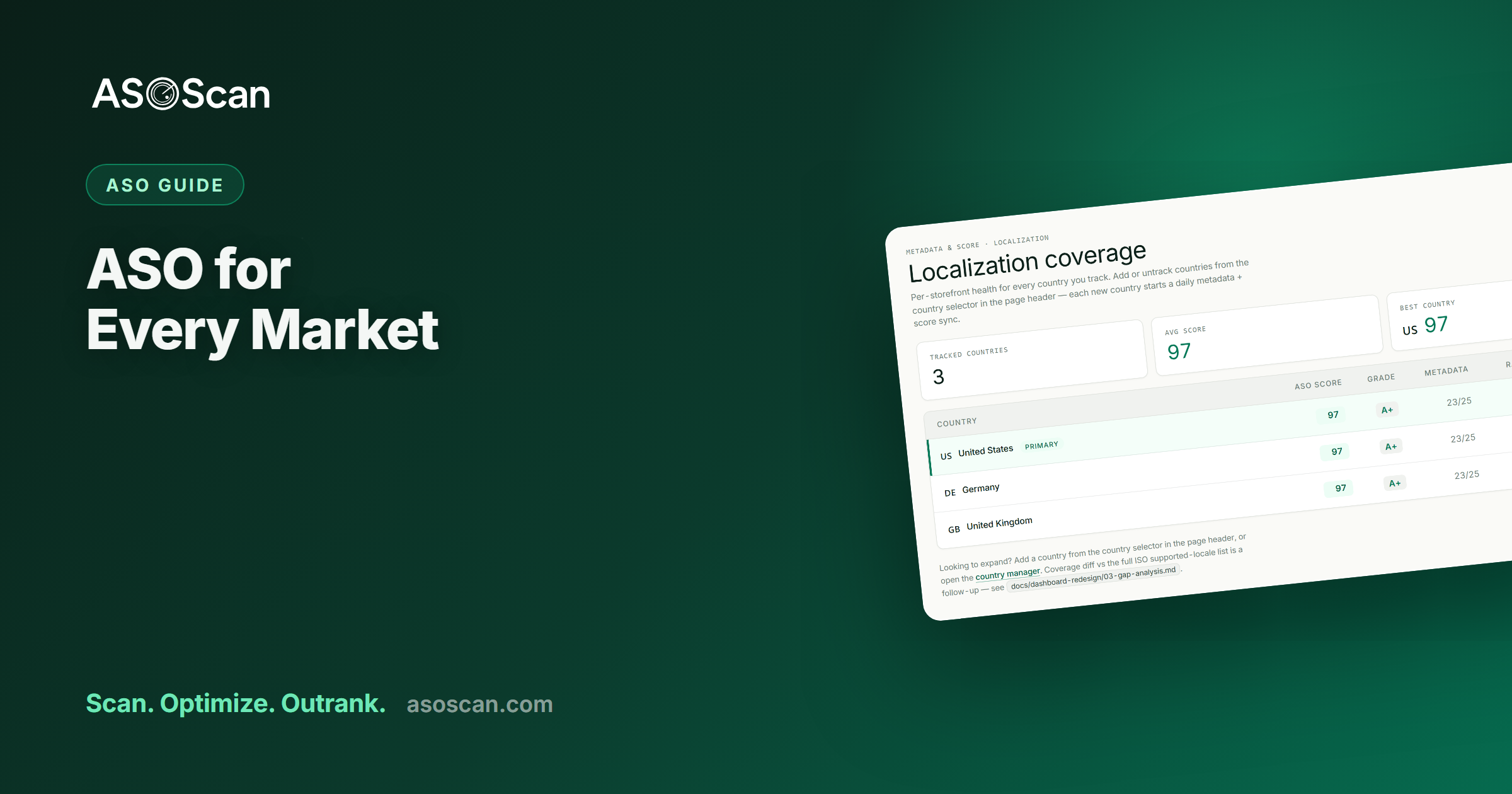
| ASO platforms | Localized keyword research and store listing optimization per market | ASOScan does keyword research, ASO scoring, and competitor tracking per locale, and its multi-country feature localizes metadata around the best keywords for each country |
| QA and screenshot tools | Verifying localized screens and generating store screenshots | Our free screenshot resizer and screenshot sizes tools get localized screenshots to the right dimensions for each store without guessing |
Before committing to any paid tooling, run your current listing through our free ASO score scan: a 60-second check that flags gaps in your existing metadata, useful groundwork before you decide which markets are worth localizing first.
How to test and quality-assure your localized app
Set the device (not just the app) to the target locale and walk every core flow: onboarding, checkout, settings. Automated translation review catches typos, not layout breaks or a mistranslated call-to-action button.
Check character limits per field, per locale, before submission. What fits in English can overflow in German or get truncated in Japanese. Our free character counter helps you check metadata length before you submit a localized listing.
Run a linguistic review with a native speaker who has never seen the source English, so they judge the localized copy on its own terms rather than comparing it back to the original.
Submit the localized build through each store's normal review process. Apple and Google both review localized metadata as part of standard app review; a rejected localization delays that market's launch the same way a rejected build does.
Measuring the success of your app localization strategy
Track conversion rate (impressions to installs) and keyword ranking separately per locale, not blended into one global number; a strong US number can hide a weak launch in a new market. Watch for a drop in uninstall rate or an increase in ratings from the localized market specifically, both signs the experience (not just the listing) is landing. Compare pre- and post-localization organic traffic for that store listing over a few weeks, since store indexing for new localized metadata isn't instant.
If you're managing several markets at once, a paid ASO tool pays for itself when a translator, a developer, and a marketer all need the same localized keyword data. ASOScan's Solo plan starts at $15/month, Pro at $59/month, Business at $149/month, and Agency at $299/month, with Enterprise available on request. Every plan includes unlimited team seats and a 7-day free trial.
FAQ
What does app localization mean?
It means adapting an app, and its store listing, so it works and reads naturally for users in a specific language and region: translated text plus locally appropriate formats, imagery, and sometimes features. Translation alone doesn't cover it.
How to change App Store localisation?
As a developer, you add or edit localizations in App Store Connect under your app's information, where you can set a localized name, subtitle, description, keywords, and screenshots per language (Apple, Localization). As a user, the App Store displays in whatever language and region your iPhone's system settings (Settings > General > Language & Region) are set to; there's no separate per-app language switch on the store side.
How do I turn on location for a specific app?
That's a different setting from app localization: it's about location permissions, not language. On iPhone, go to Settings > Privacy & Security > Location Services, select the app, and choose "While Using the App," "Always," or "Never." On Android, go to Settings > Apps > [app name] > Permissions > Location and choose the access level.
What is an example of localization?
A shopping app for the Japanese market that shows prices in yen, uses a payment method common locally (like convenience-store payment) instead of assuming credit card, formats dates as year-month-day, and uses screenshots with Japanese UI text and culturally appropriate imagery, rather than an English listing with a machine-translated description bolted on.
Do I need different keywords for each country?
Yes. Search terms vary by market even within one language, so translating a US keyword list rarely produces the terms locals search. Run a fresh keyword pass per country. ASOScan's multi-country feature finds the best keywords for each country so your localized metadata is built on real local search behavior.