How to Increase App Downloads (Organically)
Quick answer: The most cost-effective way to increase app downloads is App Store Optimization: improving where you rank in store search and how many people install once they find you. The levers, in order: keyword-optimized metadata to get seen, conversion-optimized creatives to win the install, ratings and localization to scale it, and retention to keep the algorithm surfacing you. Paid ads can accelerate, but organic ASO compounds and costs nothing per install.
Last updated: June 2026.
"How do I get more downloads?" has a hundred tactical answers and one strategic one: make your app easier to find and easier to choose. That's App Store Optimization, and it's the highest-leverage growth lever most apps have, because the majority of installs come from store search and browse. This guide is the prioritized set of levers that actually move downloads, and the ones that waste your time.
The honest answer: ASO is the highest-leverage lever
Roughly 65-70% of installs come through the app stores' own search and browse surfaces. That means how you rank and convert inside the store determines most of your organic growth. Paid ads work, but they stop the moment you stop paying; ASO keeps compounding. So before you spend on acquisition, get the free channel right.
There are five levers. Pull them in order.
Lever 1: Get seen (keywords & metadata)
You can't be installed if you're not found. Getting seen means ranking for the searches your future users type:
- Build a keyword list scored by volume, difficulty, and relevance.
- Place your best terms in the title, subtitle/short description, and the iOS keyword field.
- Target winnable long-tail terms now; chase head terms as you grow.
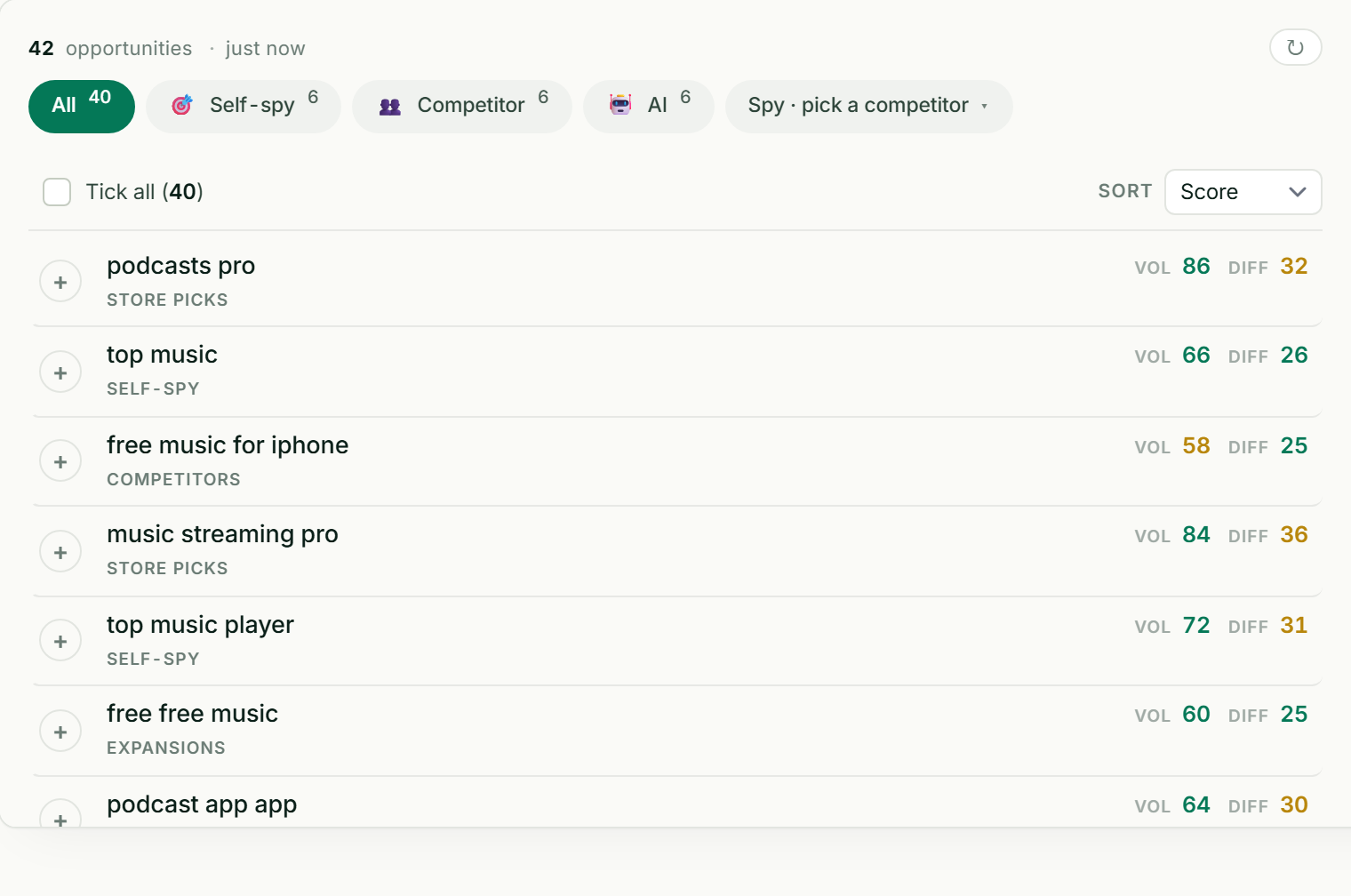
Find the keywords worth targeting, ranked from six sources into one list.
Lever 2: Win the install (conversion)
Ranking gets you the impression; conversion gets you the install. The biggest conversion levers:
- Screenshots: your strongest benefit on the first two or three. This is the single biggest conversion asset (see screenshots).
- Icon: distinct and legible small (see app icon).
- A/B test both: don't guess (see A/B testing).
A conversion rate going from 2% to 3% is a 50% increase in downloads from the same traffic, and from the same ad spend, if you run ads.
Lever 3: Scale it (ratings & localization)
- Ratings: lifting from ~4.2 to 4.6-4.7 stars typically improves conversion 30-50%. Earn them with native prompts at "win" moments (see ratings and reviews).
- Localization: every market you properly localize is a new audience and new ranking real estate. Research keywords per market, don't translate (see app localization).
These two levers multiply the first two across more users and more markets.
Lever 4: Keep them (retention & engagement)
New in the 2026 algorithms: both stores now weight retention and engagement more heavily, so a leaky app loses the rankings it earns. Downloads you can't keep don't compound, and the store stops surfacing you. Fixing the friction that churns users (often found in your reviews) protects your downloads. See what changed in ASO for 2026.
Lever 5: Accelerate with paid (optional)
Once the free channel converts, paid can pour fuel on it:
- Apple Ads can buy high-intent placements and even help jump-start organic rank for new keywords, but only spend after ASO makes your ads cheaper and your listing converts. See ASO vs Apple Search Ads.
- Paid into a listing that doesn't convert just burns money faster.
A prioritized plan
If you're starting from scratch:
- Fix the title and subtitle keywords (fastest visibility win).
- Redesign the first three screenshots (biggest conversion win).
- Turn on native rating prompts at win moments.
- Localize your top one or two markets.
- Plug retention leaks surfaced by reviews.
- Then consider paid.
What NOT to do
- Don't buy installs or use bots. It violates store policy, the installs don't retain (so they hurt your 2026 engagement signals), and you risk removal.
- Don't incentivize ratings: against the rules, and it backfires.
- Don't pour paid budget into a listing that doesn't convert: fix conversion first.
- Don't chase one viral spike: velocity without retention falls off the charts within days.
Frequently asked questions
What's the cheapest way to increase app downloads?
App Store Optimization: optimizing your keywords, metadata, and creatives so you rank and convert in store search and browse, where most installs originate. It costs your time rather than per-install spend, and unlike paid ads it keeps working after the work is done. Start with title/subtitle keywords and your first three screenshots.
How do I get more downloads without paid ads?
Pull the organic levers in order: keyword-optimize your metadata to get seen, redesign your screenshots and icon to win the install, earn ratings and localize to scale across users and markets, and fix retention so the store keeps surfacing you. Most apps can grow meaningfully on organic ASO alone before spending a cent on ads.
Does buying app installs work?
No. Avoid it. Bought or bot installs violate App Store and Google Play policy, don't retain (which now hurts you, since 2026 algorithms weight engagement and retention), and can get your app removed. There's no shortcut around building a listing that genuinely ranks and converts. Spend the effort on ASO instead.
How long does it take to increase downloads with ASO?
Metadata changes typically show up in rankings within days to two weeks as the store re-indexes; conversion improvements show up faster in your conversion rate but take a few weeks of traffic to A/B test confidently. ASO is a compounding, multi-month channel: the gains accumulate rather than arriving all at once.
The tactics here build on the complete ASO guide and how app store ranking works.