
ASO for Mobile Games: What Makes It Different
Quick answer: ASO for mobile games follows the same principles as apps but shifts the emphasis: keywords matter less, and creatives, category and chart performance, ratings, and live events matter more, because game discovery leans heavily on browsing, charts, and visual appeal. Players also search differently (genre and mechanic terms, plus "games like X"), and the icon, screenshots, and preview video carry most of the conversion. Get the visuals and the velocity right, and the keywords support them.
Last updated: June 2026.
Games are the most competitive corner of both app stores, and the ASO playbook is meaningfully different from a productivity app's. The fundamentals from the App Store Optimization guide still apply, but the weighting changes: a game lives and dies by its creatives, its charts, and its live-ops, more than by a hidden keyword field. This guide covers what's different and where to focus.
How games ASO differs from apps
- Discovery is more visual and chart-driven. Players browse genre charts, featured collections, and "what's hot" more than they type precise search queries. So charts, category, and creatives carry more weight.
- Creatives carry most of the conversion. A game is a promise of an experience, and the icon, screenshots, and especially the video sell that promise.
- Live events and updates matter more. Games run seasons, events, and content drops that drive re-engagement and featuring in ways most apps don't.
- Competition is brutal. Top game keywords and charts are dominated by huge studios, so newer games win on long-tail terms, niche genres, and creative quality.
Keywords for games
Players search differently than app users:
- Genre + mechanic terms: "merge puzzle," "idle tycoon," "roguelike deckbuilder." These describe the experience, and they're how players find new games.
- "Games like X": players hunt for alternatives to games they love. Targeting comparison-style and genre terms captures that intent.
- Theme terms: "zombie," "farm," "racing," "anime", the setting players want.
Do the same keyword research discipline (volume, difficulty, relevance), but expect the highest-volume genre heads to be unwinnable for a new game. Lean into long-tail genre and mechanic combinations.
Creatives are the main event
For games, the visual listing is most of the pitch:
- Icon: has to pop in a grid of polished game icons and signal the genre and vibe instantly (see app icon).
- Screenshots: show actual gameplay, not just menus or splash art. Lead with the most exciting moment, and use captions to convey the hook (see screenshots). Whether iOS reads those captions is contested: Appfigures reported it in June 2025, a ConsultMyApp test found only 1 of 64 screenshot-derived phrases ranking, and Apple has never documented it. Write them for the reader.
- Preview video: more important for games than for almost any app category: players want to see the game move before they install. Lead with gameplay in the first seconds.
A/B test all three relentlessly (A/B testing). For games, creative testing often produces the biggest wins.
Charts and category matter more
Game discovery is chart-heavy, so category and chart performance carries extra weight:
- Pick the right genre category: it places you in the charts players actually browse.
- Velocity breaks you in; retention holds you. Games are subject to the same 2026 hybrid model: a launch or event spike gets you onto a chart, and retention keeps you there.
- Top-grossing vs top-free are different games; know which chart your monetization targets.
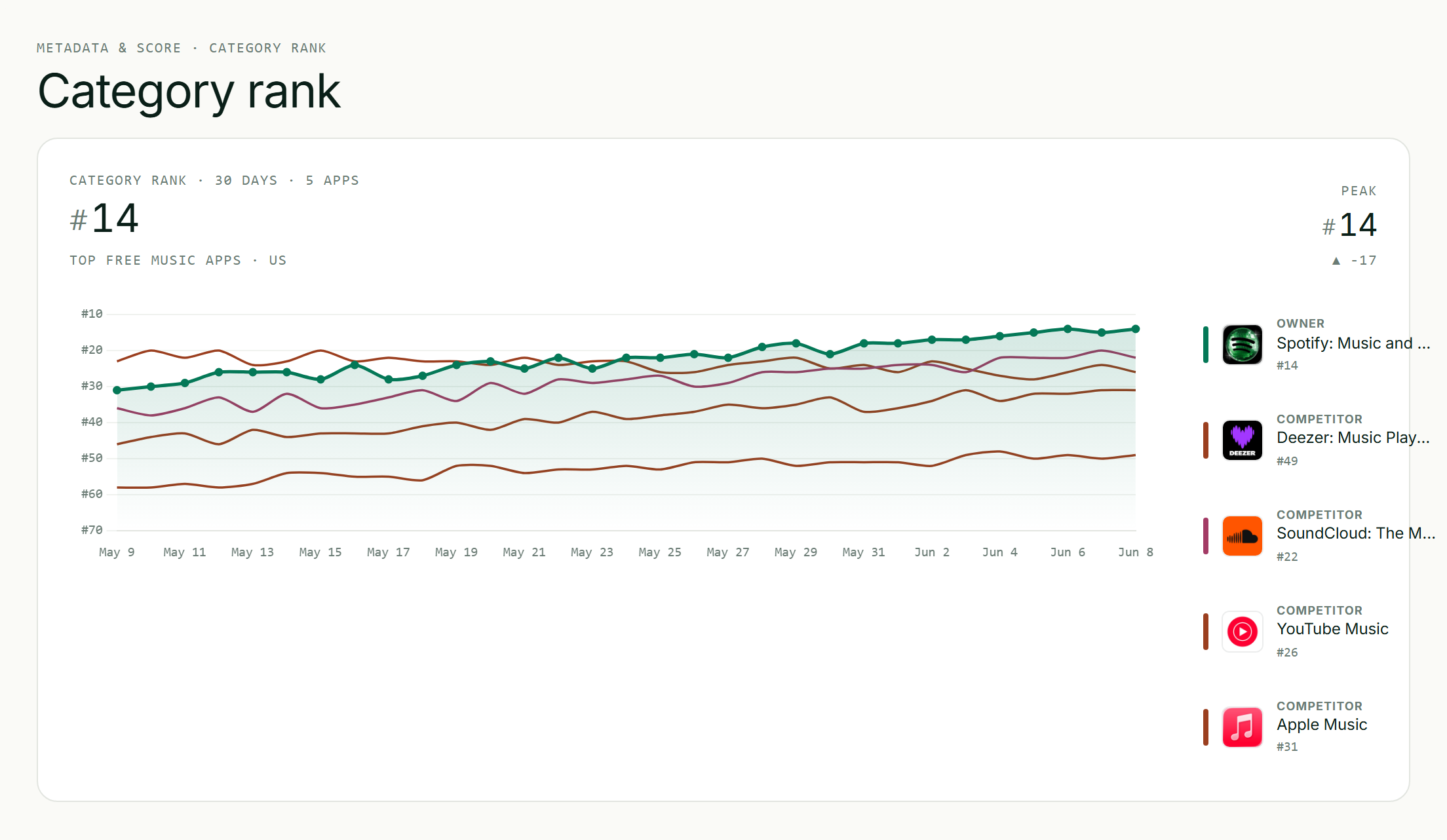
Track your genre-chart position over time: momentum shows before it peaks.
Ratings and live events
- Ratings: games get rated emotionally: a frustrating difficulty spike or an aggressive paywall tanks ratings fast. Prompt after a win (a level cleared, a boss beaten), never mid-frustration. See ratings and reviews.
- Live events: in-app events and seasonal content show up as discovery surfaces and signal an active game. They drive re-engagement and make you a stronger featuring candidate.
Localization is non-optional for games
Games travel across cultures better than most apps, and key gaming markets (Japan, South Korea, China where applicable, Brazil, Germany) reward native localization heavily, in both the metadata and the creatives. A localized store listing with localized screenshots routinely outperforms an English-only one in those markets. See app localization.
Featuring: the games jackpot
Both Apple and Google love showcasing great games, and a feature drives a massive install burst. You earn it with polished design, a strong launch, live events, timely updates, and following the guidelines. Keep your App Store Connect featuring pitch current and time it to a content moment.
Common game ASO mistakes
- Splash art instead of gameplay in screenshots and video: players want to see it play.
- Chasing unwinnable genre head terms instead of long-tail mechanic/theme combinations.
- Skimping on the preview video: for games it's a primary conversion asset.
- Prompting for ratings mid-frustration instead of after a win.
- Shipping English-only in markets that reward native localization.
- Treating ASO as launch-only: games live on live-ops; keep optimizing.
Frequently asked questions
Is ASO different for games than for apps?
Yes. The principles are the same but the weighting shifts. For games, creatives (icon, gameplay screenshots, preview video), category and chart performance, ratings, and live events carry more weight, while the hidden keyword field carries relatively less. Players also discover games through browsing and charts more than precise search, and they search by genre, mechanic, and "games like X."
What keywords should a mobile game target?
Genre and mechanic terms ("merge puzzle," "idle tycoon," "roguelike"), theme terms ("zombie," "farm," "racing"), and comparison terms ("games like [popular title]"), the words players use to describe the experience they want. The highest-volume genre heads are usually dominated by big studios, so a newer game should target long-tail combinations of genre, mechanic, and theme.
How important is the preview video for games?
Very, more than for almost any app category. Players want to see a game in motion before installing, so the preview video is a primary conversion asset, not a nice-to-have. Lead with actual gameplay in the first few seconds (not logos or cutscenes), and A/B test it, since video changes often produce large conversion swings for games.
How do games get featured on the App Store?
By being polished and active: strong design, a solid launch, in-app events and seasonal content, timely updates, and full guideline compliance. On iOS you can also submit a featuring pitch in App Store Connect. Keep it current and time it to a content moment. A feature drives a large install burst that can launch a game up the genre charts, where retention then holds the position.
Should I localize my game's store listing?
Yes. Games reward localization heavily, especially in major gaming markets like Japan, South Korea, Brazil, and Germany. Localize both the metadata (with per-market keyword research, not translation) and the creatives, including screenshots. A natively localized listing routinely outperforms an English-only one in those markets, often by a wide margin.