App Store Optimization Services in 2026: What You're Actually Buying

App store optimization services are agencies, freelancers, or software subscriptions that improve how your app ranks in App Store and Google Play search. They also improve how many visitors to your store page install the app. Buying one is a decision about scope and workflow. It is not a decision about which vendor owns secret keyword data.
App Store Optimization (ASO) is the work of choosing your keywords, metadata, and creatives. These decide whether your app appears in store search, and whether a visitor taps Install. The word "services" covers three different things: a done-for-you agency, a freelancer who does metadata passes, and a self-serve tool that you operate. All three solve the same problem with a different labor model. The right choice depends on whether you have more time or more budget.
The three shapes of app store optimization services
An ASO agency, or ASO company, sells you people. The usual scope is keyword research, metadata rewrites, screenshot design, localization, and a monthly report. The benefit is speed and coverage in markets whose language your team does not speak. The cost is the feedback loop. Nobody at the agency knows your onboarding funnel or which feature your users care about. So the creative brief often comes from a competitor teardown, not from your product.
Freelancers sit in the middle. A good freelancer does an audit, fixes your indexed fields, and gives you a keyword map that you can maintain. The risk is continuity. A person who handles six apps will put yours second in the month that a bigger client signs.
Software is the third shape. You add your App Store and Google Play listings. The tool tracks your rankings and keyword movement in every storefront that you choose, and you make the edits. ASOScan is a tool of this kind, for a single app and for teams with many apps. The trade is time against money. Software does not design your screenshots, but it also does not guess about your product.
Agencies use software too. ASOScan's Agency plan covers about 150 client apps with unlimited seats, so an agency can run its whole client list in one place. If you hire an agency, ask which tool it uses and whether you can see the same data.
There is no correct ranking of the three. A studio that ships 40 localized apps needs an agency or a team. A developer with one app and a free Saturday needs software.
How app store optimization services get you visibility
No service changes the ranking algorithm of a store. A good service changes two things: which search terms your listing can rank for, and how often visitors install the app. Everything else follows from those two.
The work has two halves. First, pick terms that are worth ranking for and put them in the fields that the store indexes. Second, measure whether your rank moved and whether the install rate per store page view moved with it. Many cheap services stop after the first half, because the install rate comes from your analytics, not from their dashboard.
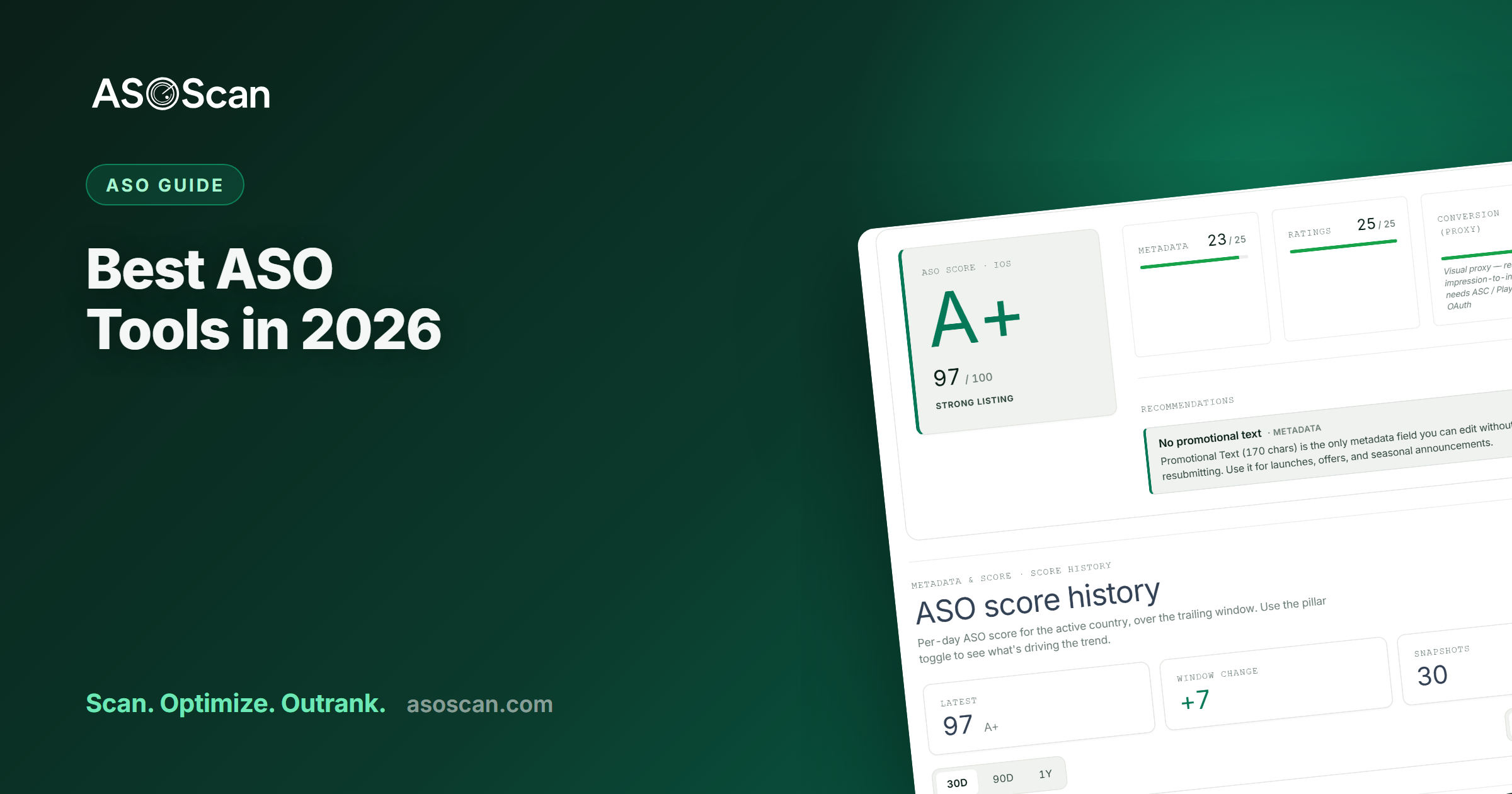
Before you talk to any provider, run a free ASO score scan on your listing. It takes about 60 seconds and shows which indexed fields are empty or misused. With that result in hand, the sales call changes from "trust us" to "fix these six things."
Judge keyword opportunity with data for each term. In the US, "app store optimization" gets about 1,000 searches a month, with a difficulty of 50 out of 100. "App store optimization tools" also gets about 1,000 searches a month, but its difficulty is 14. The demand is the same, and the longer term is much easier to rank for. That is why a long-tail term is usually the better first target. A provider must be able to show you the same kind of table for every term that it plans to target for your app.
On the App Store (iOS): what Apple reads
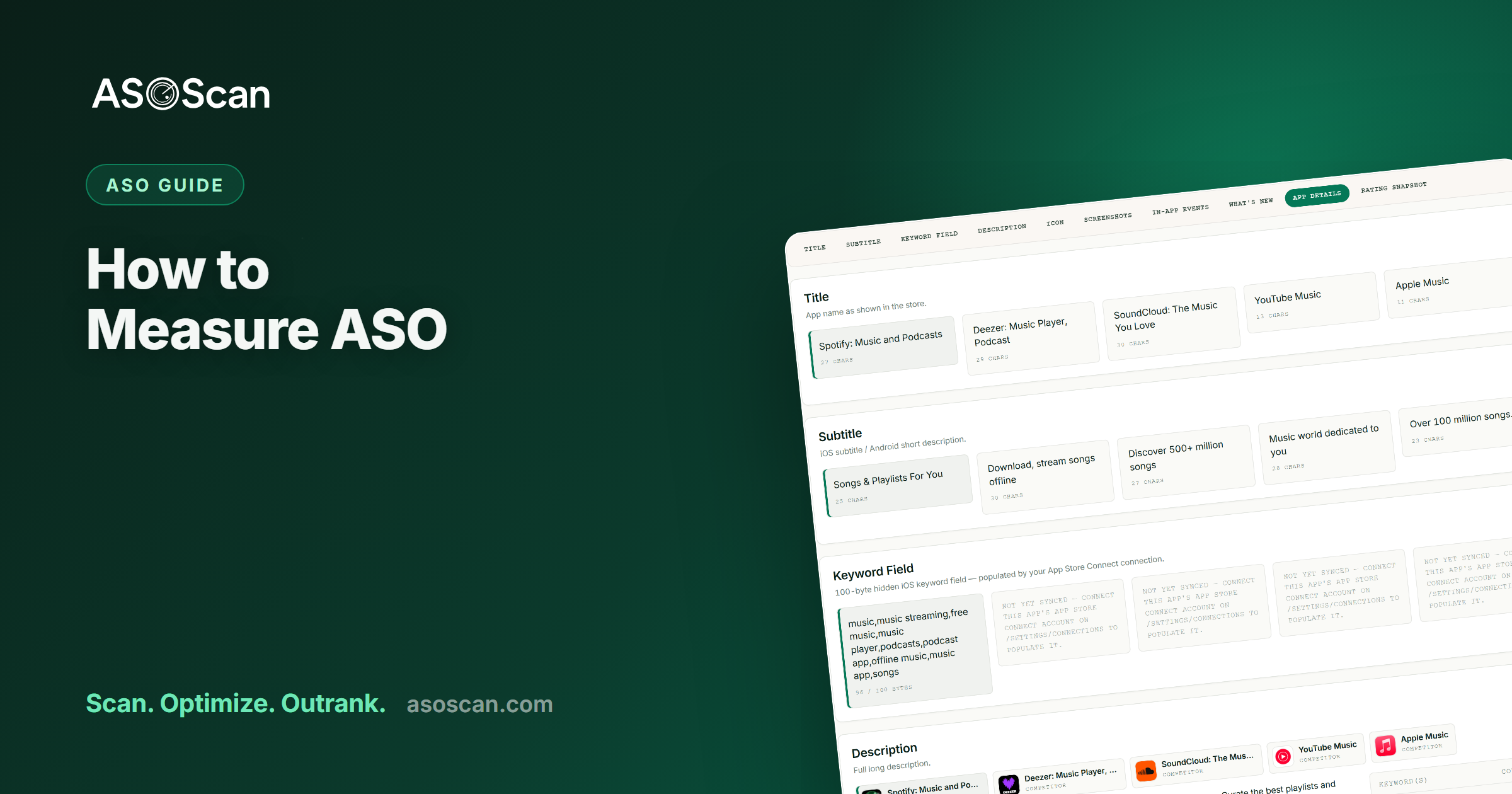
Apple's search page names the text that it matches for relevance. That text is your app name, your subtitle, your keywords, and your primary category. The long description is not on that list. Treat the description as a conversion asset for people who are deciding whether to install. Keywords that you stuff into it do not help your rank, and they make the text harder to read.
Apple also combines words across those fields. So a word that is already in your app name does not need to appear again in the subtitle or the keyword field. A repeated word, or a singular next to its plural, uses space that another word can fill. The keyword field takes terms separated by commas, with no spaces after the commas. Apple also tells you not to put category names or the word "app" in it.
If a service tells you to write keywords into your App Store description, its advice is out of date. Apple publishes the rules for each field on its App Store product page documentation. Read the live page rather than a table in a blog post, including this one.
Apple also gives you promotional text, a short field that you can change without a new build. It is not a search field. Use it for a launch, a sale, or a seasonal message.
On Google Play (Android): what Google reads
Google Play has no hidden keyword field. Your keywords must live in text that people read: the title, the short description, and the full description. Google's policy treats keyword stuffing as a violation. A phrase repeated twenty times in the description leads to a rejection, not a higher rank.
That one difference changes the whole job. On Google Play, a keyword plan is a writing plan. You choose which search phrases appear naturally in the title, the short description, and the first sentence of the full description. Then you write the copy around them. If a provider gives you the same keyword-stuffed metadata for both stores, it did not study the two stores separately.
Google also requires a feature graphic for the store listing, and it has its own rules for screenshots and preview videos. Promotional text does not exist on Google Play. If a service charges you for "promotional text localization" on Google Play, that line buys nothing.
Comparing the two stores field by field
| Surface | App Store (iOS) | Google Play (Android) |
|---|---|---|
| Hidden keyword field | Yes, comma-separated, no spaces | Does not exist |
| Long description in search | No, conversion text only | Yes, indexed text |
| Short description | No equivalent field | Yes, indexed |
| Promotional text | Yes, not a search field | No equivalent |
| Required feature graphic | No | Yes |
| Keyword stuffing | Wastes space | Policy violation risk |
The two stores agree on some points. The app name carries weight on both. Ratings and reviews count on both: Apple lists them among the user signals that affect search results, and on both stores they affect whether people install. Screenshots do conversion work on both. A provider who says the two stores are the same will give you one weak metadata set. A provider who invents differences is padding the invoice.
What to demand from a provider before you pay
Ask for four things, and watch how the provider answers.
First, a plan for each field. A keyword list is not enough. You need a map that says which term goes in which field on which store. If a provider cannot produce that map, it sells research without execution.
Second, the numbers for each proposed term: monthly search volume and difficulty. Look at the mix of head terms and long-tail terms. For example, "aso" gets about 18,100 searches a month in the US at a difficulty of 38. It is a broad head term that a new app will not win soon. A plan that targets only hard head terms produces a good-looking report and no rank movement. For your own category, ask what the target terms add up to, and at what difficulty.
Third, reports that keep rank and conversion apart. Rank movement tells you that the metadata worked. The install rate per store page view tells you that the creatives and first screenshots worked. A monthly report with a rank chart and no conversion line is half a report.
Fourth, a plan for ratings and reviews, and a clear list of what the provider will not touch. Ratings and reviews are a real lever. A low average rating hurts you, and so do only a few reviews, because both stores show them to every visitor and Apple counts them in search. Ask how the provider will help you earn more and better ratings within the store rules. Review replies and ad campaigns are different. Replies help support and the people who read the thread, and ads buy a paid placement. Neither one raises your organic rank. The paid and organic sides work best together, as the comparison of ASO and Apple Search Ads explains.
On price, ASOScan has five plans: Solo at $15 a month, Pro at $59, Business at $149, Agency at $299, and Enterprise on custom terms. Every plan includes unlimited team seats and a 7-day free trial. If you compare against another provider, ask for its price in writing. Do not trust a comparison table, including this one.
When to hire an ASO agency, and when to buy software
Hire an agency when you enter markets that your team cannot judge, or when you need screenshot and video production. An agency also makes sense when nobody on the team has time for a dashboard twice a week. Hire a freelancer for a one-time audit and metadata rebuild, and then maintain the result yourself.
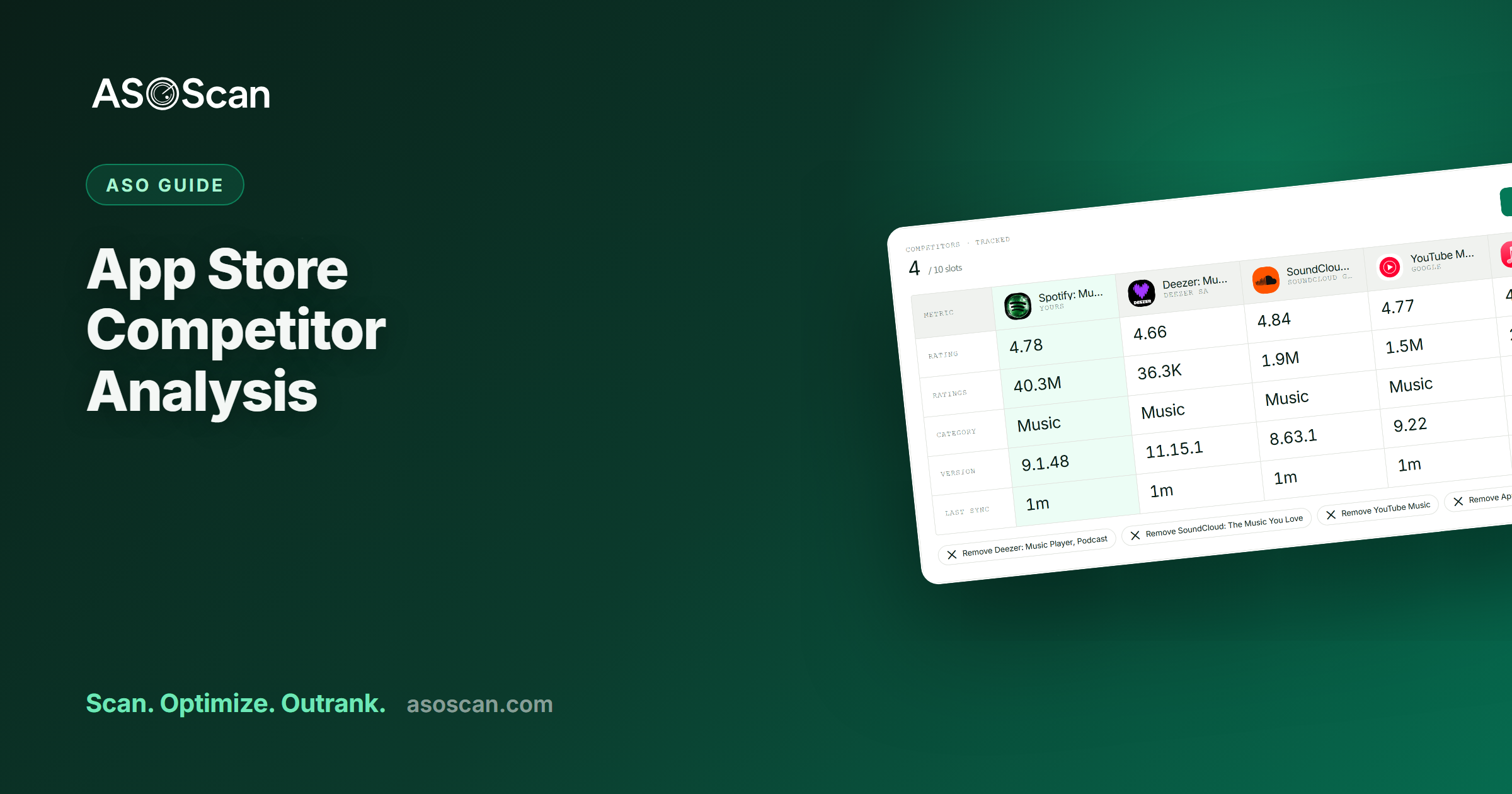
Buy software when one person on the team can own ASO as a weekly habit. The routine is simple. Look at the rank movement of your tracked terms, look at what your competitors changed, rewrite one field, and watch the store page conversion rate for two weeks. Then keep the change or revert it. ASOScan is built for that routine. It gives you keyword tracking in every market, an ASO score, competitor tracking, and review sentiment. Its AI metadata suggestions are drafts that you edit before you use them.
If you still cannot decide between self-serve and done-for-you, use this test: a service will not know your product better than you do. Buy hours only where hours are truly scarce.
FAQ
What are app store optimization services?
They are providers that improve how your app ranks in App Store and Google Play search, and how well your store page converts visitors. The work covers keyword research, metadata edits, creatives, and reporting. The delivery can be an agency retainer, a freelancer, or a software subscription that you operate.
Is app store optimization legal?
Yes. Editing your own metadata, creatives, and localization is normal publishing on both stores. The limit is policy. Fake reviews, paid ratings, and keyword stuffing break Apple's App Review Guidelines and Google Play's spam and metadata policies. Both companies update these rules, so read the live versions.
Does app store optimization actually work?
ASO changes which search terms your listing can rank for and how many visitors install the app. Those two things move downloads, and good ASO improves your organic rank. ASO does not guarantee a position. No tool or agency controls the ranking algorithms. A promise of a top-10 place within a fixed number of months is a guess paid with your budget. Measure rank and store page conversion separately, and give each metadata change about two weeks.
What is the difference between ASO on iOS and Google Play?
Apple matches your app name, subtitle, keyword field, and primary category, and the long description is not on its list. Google Play has no keyword field. It reads the title, the short description, and the full description, so your keywords must sit in copy that reads naturally. Google also requires a feature graphic. One metadata set written for both stores is wrong for at least one of them.
How much do app store optimization services cost?
Agencies usually charge a monthly retainer that grows with the number of apps and languages. Freelancers charge per audit or per month. Software charges a flat subscription. ASOScan starts at $15 a month for Solo and goes to $299 a month for Agency. Every plan has unlimited team seats and a 7-day free trial. Compare what each option covers, not only the price.
Can I do ASO myself instead of hiring a service?
Yes. For a single app in one market, it is usually the better first step. Start with a free scan to find empty or misused fields. Fix your App Store keyword field and your Google Play title and short description. Then track a small set of terms every week. When you add five more languages, an agency can start to earn its fee.